


Arvell Reese is an Elite Prospect, But What’s His Ideal Role?
- Ryan McCrary

- Mar 21
- 6 min read

What happens when an edge rusher is elite at almost everything but doesn't fit the traditional mold?
That's the question NFL teams will have to answer when evaluating Ohio State linebacker Arvell Reese. He's an explosive athlete who defends the run at a high level, rarely misses tackles, and consistently wins reps as a pass rusher. That's a rare combination for any edge rusher prospect.
But there's a catch.
Reese isn't the biggest guy, and he isn't a traditional defensive end. This makes his evaluation trickier than you'd expect for a player this talented because he may not fit every single defensive scheme.
Today, we're going to break down what makes Arvell Reese an elite prospect and what his ideal role will be in the NFL.
What Makes Arvell Reese So Special?
Arvell Reese is EDGE1 on the consensus big board, and it’s easy to see why he has become the favorite to be the first defensive player selected in the 2026 NFL Draft.
First off, his ability to defend the run despite being just 241 lbs. is absolutely special. One thing that makes him so good at stopping the run is that he is incredibly explosive coming off the line of scrimmage, and he put this on display on a run stop vs. Illinois this season.
The Fighting Illini ran inside here on third and one, and at the beginning of the play, it looked like there might be an option for the quarterback to keep the ball. However, the Buckeyes stacked the left side of the line of scrimmage, so the quarterback handed the ball off, and Arvell Reese exploded from the left side of the offensive line to the right to bring down the running back before he could pick up the first down.
Reese is also very comfortable with disengaging from run blockers to attack ball carriers, and he did this in the second half against UCLA.
The Bruins ran the ball on 3rd and 22, and the running back tried to go outside, following his left tackle, who was pulling on the play. The running back had some space to pick up a decent gain, but Reese disengaged from his blocker, and he got to the running back and brought him to the ground just a few yards ahead of the line of scrimmage.
Arvell Reese is one of the best run-defending edge rushers we've seen in recent memory, as his career PFF run defense grade at Ohio State was 82.8, a mark that ranks in the 94th percentile among edge rusher prospects since 2017.
Another reason why Reese is so good against the run is that he is very effective at tackling ball carriers, and this is an underrated trait for edge rushers. He is not the type of tackler who hunts for big hits to force fumbles. Instead, he wraps up and makes sure that ball carriers do not escape from his grasp.
Wisconsin tried to run a sweep with a receiver against Ohio State this season, but it did not work because Arvell Reese kept his eye on the ball carrier, got squared up, and wrapped up the receiver to bring him to the turf.
Reese’s effectiveness as a tackler makes him really dangerous as a QB spy, and we saw this on display when Ohio State played Washington. This play was on 3rd and goal from the 10-yard line, and the Huskies were trying to throw the ball. Huskies quarterback Demond Williams ended up taking off with the ball, but Reese got to him and tackled him for no gain.
Reese was a very good tackler across his collegiate career, and his PFF tackling grade (77.0 | 94th percentile) and his career missed tackle rate (11.9% | 71st percentile) are both very good for edge rusher prospects historically.
Arvell Reese is a fantastic run stopper, but he's also great at rushing the passer. He had a dominant pass-rush rep vs. Penn State this year, in which he showed how his 4.53 speed makes him extremely difficult to contain.
He started this play standing up, and he essentially got a running start before engaging with the left tackle. Once he reached the left tackle, he dipped his shoulders, which prevented the tackle from being able to put his hands on him. After this, he exploded past the tackle and took the quarterback down for a sack.
Reese is incredibly productive rushing the passer, especially when going up against true pass sets. He faced true pass sets on 43.8% (87th percentile) of his pass rushing snaps in college, and he won 29.8% (91st percentile) of those reps, an elite pass rush win rate for those situations.
This is very important because any pass rusher can win reps and generate pressure on blitzes and stunts or when facing lots of play-action passes. However, it takes a really good pass rusher to be elite when going one-on-one with tackles on pure dropbacks.
With Reese, you get an explosive athlete who rarely misses tackles, defends the run at a high level, and is elite at winning reps as a pass rusher. It's not common to see edge rusher prospects who are great in all of these areas, and it's why Reese is one of the better edge rusher prospects in recent memory.
Still, there are two things that make his evaluation a bit trickier than you'd think. That is his size and his role.
What is Arvell Reese's Ideal Role?
Arvell Reese doesn't lack length, as he's 6'4 and has 32-inch arms. Even at 241 lbs., he has good size for a linebacker, which you can see by his relative athletic score page.

But what if we look at his physical measurements compared to all defensive ends who have ever been invited to the NFL combine? When we do that, his size becomes a glaring weakness.
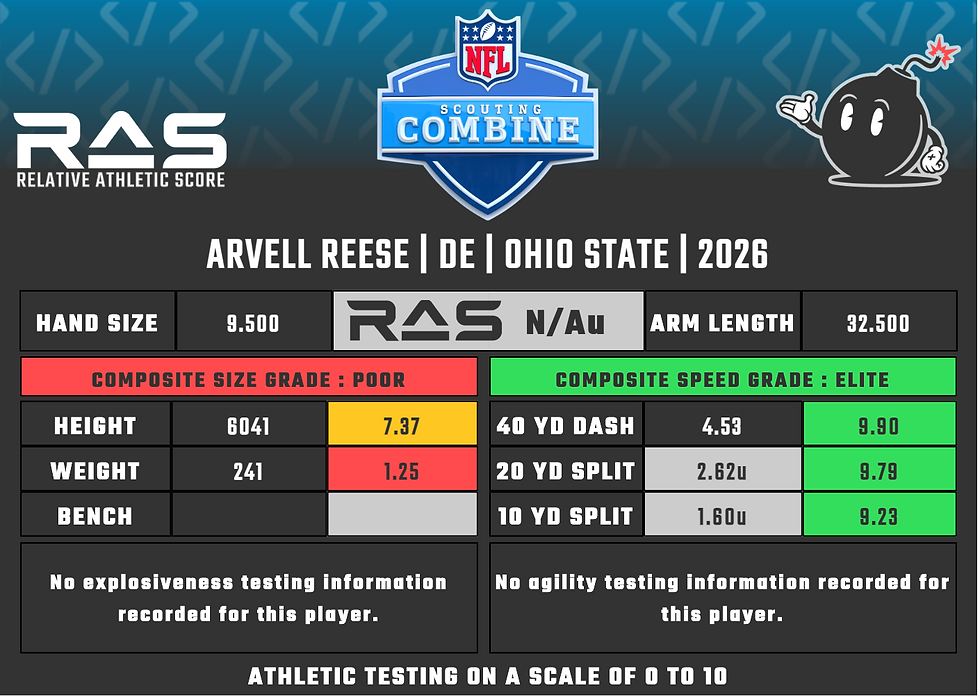
This alone doesn't scare me that much because Reese was incredibly productive across the board at Ohio State. However, I think it's fair to wonder how his ability to take on run blockers will translate to the NFL since he has such a light frame.
On top of this, this likely limits what roles he can fill at the next level because he doesn't have the size or strength to be a true defensive end. He definitely didn't play this role in college, as 43.9% of his snaps in 2025 came in the box as an off-ball linebacker.
This is where Reese's evaluation gets interesting. Some NFL teams may not like that he isn't a traditional defensive end, and he may not be a good fit for every scheme because of it. So what is his ideal role in the NFL?
There's an easy answer to this. Reese's athleticism and versatile skillset allow him to line up all over the field and take on assignments that bigger edge rushers may not be able to handle.
He can line up as a 9-tech or wide-9 pass rusher who lines up way outside the tackle, and this would allow him to weaponise his burst off the line of scrimmage to beat opposing pass protectors.

He can also line up off the ball as a linebacker, where teams can use him as a blitzer or a QB spy.

You see, his lack of size may be a problem for some schemes, but he has such a well-rounded skillset, and he's such an excellent athlete that defensive coordinators can use him to attack offenses in unique ways. You wouldn't line up Aidan Hutchinson at linebacker and ask him to be a quarterback spy, but you can do that with Reese. That's the unique edge he provides over other prospects.
It's not hard to imagine Reese becoming one of the NFL's most disruptive defenders within a few years. He has the athleticism, the production, and the instincts. All he needs is a team willing to let him be what he is instead of forcing him into a box he was never meant to fit in. If he lands in the right system, he'll be a problem for opposing offenses.
Thank you for checking out this piece. If you enjoyed it, feel free to subscribe to our website by clicking the button below so you never miss our posts. Take care and God bless!


Comments